SCT — Map Sections
An
.sctfile is a reusable chunk of map terrain — Cavedog's level designers stitched dozens of these together in the official map editor (TAE) to build the finished.tntmaps. Each section bundles its own tile graphics, tile grid, per-cell heights, and a thumbnail minimap. They are the building blocks; TNTs are the assembled product.
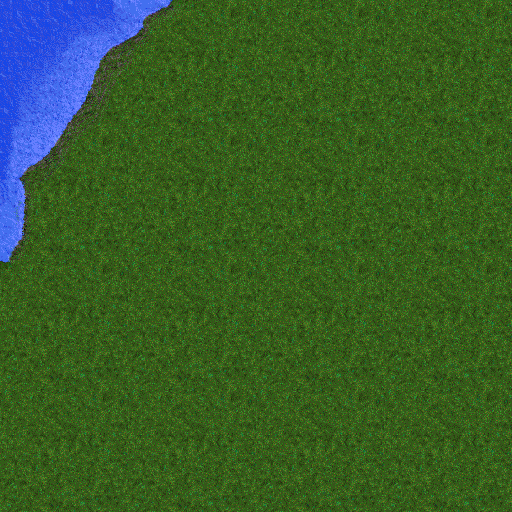
sections/greenworld/coast/b_n_w02_135.sct rendered by kbot sct image

Embedded minimap (left) and elevation grid (right).
Tip
Try it yourself.
kbot sct info       sections/greenworld/coast/b_n_w02_135.sct
kbot sct describe   sections/greenworld/coast/b_n_w02_135.sct
kbot sct image      sections/greenworld/coast/b_n_w02_135.sct -t out.png
kbot sct minimap    sections/greenworld/coast/b_n_w02_135.sct -t mini.png
kbot sct heightmap  sections/greenworld/coast/b_n_w02_135.sct -t height.png
See the CLI kbot sct reference.
From Go. Use formats/sct:
import "github.com/coreprime/kbot/formats/sct"

f, _ := os.Open("sections/greenworld/coast/b_n_w02_135.sct")
defer f.Close()
s, _ := sct.LoadFromReader(f)
fmt.Printf("%dx%d tiles, %d unique, %d heights\n",
    s.Header.Width, s.Header.Height, s.Header.NumTiles, len(s.HeightMap))
On-disk layout
┌─ Header (28 B) ──┐  version, pointers, dimensions
├─ Tile pixels ────┤  NumTiles × 1024 bytes (32×32 palette indices)
├─ Section data ───┤  Width × Height × int16 tile indices
├─ Height grid ────┤  (Width × 2) × (Height × 2) × {4 or 8} bytes
└─ Minimap ────────┘  128 × 128 palette indices
The pointer fields can target sections in any order, but Cavedog's tooling emits them in the layout shown above and that's what every third-party reader assumes.
Header (28 bytes)
typedef struct {
    uint32 Version;     // 2 or 3 (TA's TAE always emits 3)
    uint32 PtrMinimap;  // → 128×128 minimap
    uint32 NumTiles;    // unique 32×32 tile count
    uint32 PtrTiles;    // → tile pixel block
    uint32 Width;       // section width in tiles
    uint32 Height;      // section height in tiles
    uint32 PtrData;     // → tile-index grid + heights
} SCTHeader;| Field | Notes |
|---|---|
Version |
3 for retail TA sections. Some early prototypes use 2 — same layout but height entries are 8 bytes instead of 4. kbot accepts both. |
Width, Height |
Both expressed in tiles (32 px units). For a TAE-compatible section both must be multiples of 4 (i.e. multiples of 128 px). |
NumTiles |
Unique tile count. The index grid in the data section refers into this array. |
Tile pixels
NumTiles blocks of 32 × 32 = 1024 bytes each — palette indices into
the TA palette. Identical tiles are not deduplicated automatically by
the format, so a poorly-built section may waste space; kbot's image
command will warn if a section has unreachable tiles.
Section data — tile indices + height grid
int16 tileMap[Height][Width];     // Index into the tile pixel array
                                  // (signed; negative values are unused
                                  // in retail content but valid)

struct HeightCell_V3 { uint8 h; int16 always_minus_one; uint8 always_zero; };
struct HeightCell_V2 { uint8 h; int16 always_minus_one; uint8 always_zero;
                       uint32 reserved; };

HeightCell heights[Height * 2][Width * 2];
The height grid is four times denser than the tile grid — every tile
gets 2 × 2 = 4 height samples at 16-pixel resolution, matching how TNT
attribute cells work. The always_-1 and always_0 fields are scratch
metadata from the editor; you can write either value back on round-trip.
Minimap
128 × 128 palette indices. The dimensions are fixed regardless of the
section's tile width/height, and the minimap is stretched to fit the
section's aspect ratio rather than letterboxed.
Reading order
header = read_struct(SCTHeader)
assert header.Version in (2, 3)

seek(header.PtrTiles)
tiles = [read(1024) for _ in range(header.NumTiles)]

seek(header.PtrData)
tile_map = read_int16_array(header.Width * header.Height)

entry_size = 4 if header.Version == 3 else 8
attrs_w, attrs_h = header.Width * 2, header.Height * 2
heights = [read(entry_size)[0] for _ in range(attrs_w * attrs_h)]

seek(header.PtrMinimap)
minimap = read(128 * 128)
Worked example — b_n_w02_135.sct
$ kbot sct describe sections/greenworld/coast/b_n_w02_135.sct
Version:    3
Section:    4 × 4 tiles  (128 × 128 px)
Tiles:      64 unique
Heights:    8 × 8 cells (height range 50–62)
Minimap:    128 × 128
A 4×4 tile section is the smallest TAE will accept (must be multiples
of 128 px). Despite the section having 4 × 4 = 16 placements, it
references 64 unique tiles because each 32×32 cell is itself bounded by
edge transitions that the designer wanted variations of. This is normal —
sections trade storage for blending freedom.
How TNT uses sections
A .tnt map's tile pool is the union of every .sct the level designer
"painted" into it, deduplicated after the fact by TAE. So when you find
two TNTs share a tile, it almost always came from the same SCT.
The connection is build-time only. The runtime engine never opens a
section; it only sees the already-combined TNT. Sections live on disk in
the editor archives (worlds.hpi) and the campaign world archives, e.g.
sections/greenworld/coast/, sections/lava/hills/, etc.
Gotchas
Warning
Width × Height must be a multiple of 4 for TAE to load the section.
The format itself doesn't enforce this — you can write a 3×3 tile
section and kbot will happily render it — but Cavedog's editor will
reject it with a cryptic "section misaligned" error.
Version == 2has 8-byte height cells, not 4. The first byte is still the elevation; the remaining 7 bytes are editor scratch you can zero on write.- The 128×128 minimap is stretched, not letterboxed, to fit the section's aspect ratio. A 4×16 section will look horribly squished in the minimap.
- There's no signature beyond
Version. To validate a candidate SCT, check thatVersion ∈ {2, 3}and that the four pointer fields all fall inside the file. - Height ranges are entirely up to the designer. TAE clamps to 0–255 but a section can be perfectly flat (single value) or full-range. The TNT renderer normalises before display; the SCT does not.
Typical sizes
| Asset | Range observed in Cavedog sections/**/*.sct |
|---|---|
| File size | 30 KB – 2 MB |
| Section dimensions (tiles) | 4×4 – 32×32 |
| Unique tiles per section | 30–600 |
| Header overhead | always 28 bytes |
| Minimap (always 128×128 paletted) | 16384 bytes |
Sections in worlds.hpi |
~5000 (across all biomes) |